Walford Nursery & Primary School
Progression in Science: Chemistry
Science National Curriculum
Progression in Chemistry
Subject Key Objective Progression & Development by Year Group
The following is a guide to help you understand your child's progression through school.
All lessons are effectively differentiated to ensure that all children can achieve the objective set.
Chemistry Knowledge - EYFS
In EYFS, children will:
- explore materials with different properties;
- explore collections of materials with similar and/or different properties;
- talk about the differences between materials and changes they notice.
Chemistry Knowledge - Year 1
In Year 1, children will:
- know the name of the materials an object is made from;
- identify and name a variety of everyday materials, including wood, plastic, glass, metal, water and rock;
- know about the properties of everyday materials;
- compare and group together a variety of everyday materials on the basis of their simple physical properties.
Chemistry Knowledge - Year 2
In Year 2, children will:
- know how materials can be changed by squashing, bending, twisting and stretching;
- know why a material might or might not be used for a specific job
Chemistry Knowledge - Year 3
In Year 3, children will:
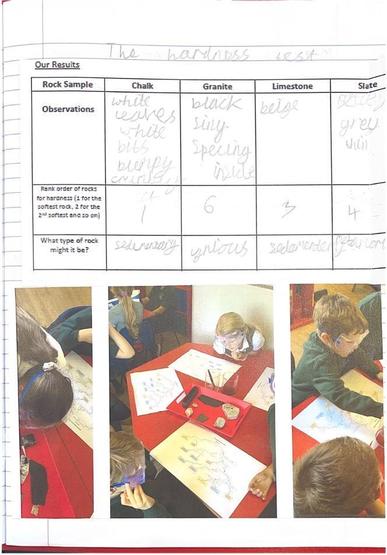
- compare and group rocks based on their appearance and physical properties, giving reasons;
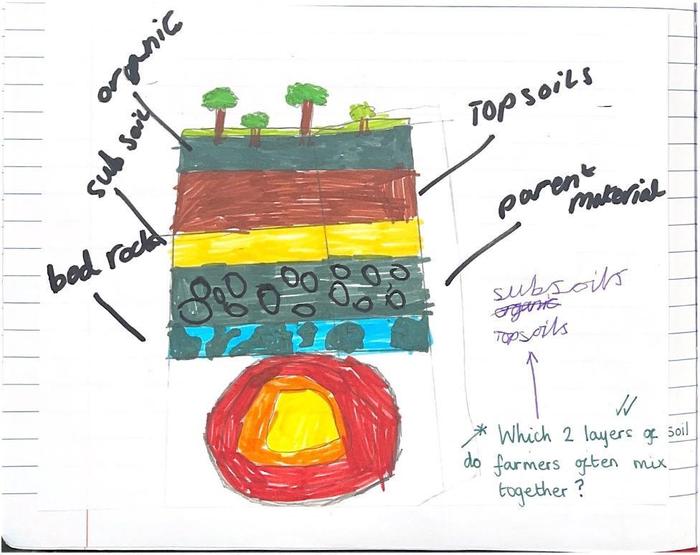
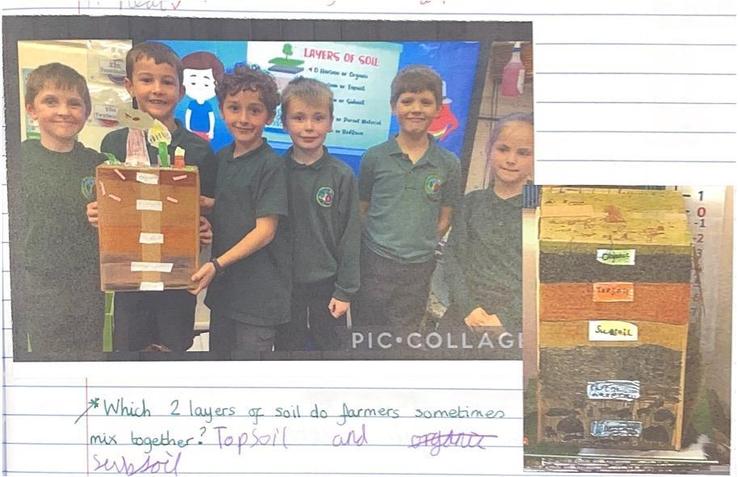
- know how soil is made and how fossils are formed;
- recognise that soils are made from rocks and organic matter;
- know about and can explain the difference between sedimentary, metamorphic and igneous rock.
Chemistry Knowledge - Year 4
In Year 4, children will:
- compare and group materials together, according to whether they are solids, liquids or gases;
- observe that some materials change state when they are heated or cooled and measure or research the temperature at which this happened in degrees Celsius;
- know the part played by evaporation and condensation in the water cycle and associate evaporation with temperature.
Chemistry Knowledge - Year 5
In Year 5, children will:
- compare and group materials based on their properties (e.g. hardness, solubility, transparency, conductivity, [electrical & thermal], and response to magnets;
- give reasons, based on evidence from comparative and fair tests for the particular uses of everyday materials, including metals, wood and plastic;
- know and can explain how a material dissolves to form a solution;
- know and can show how to recover a substance from a solution;
- use their knowledge of solids, liquids and gases to decide how materials can be separated (e.g. through filtering, sieving and evaporating);
- demonstrate that dissolving, mixing and changes of state are reversible changes;
- explain how some changes result in the formation of a new material and that this is usually irreversible – include burning and acid on bicarbonate of soda.